
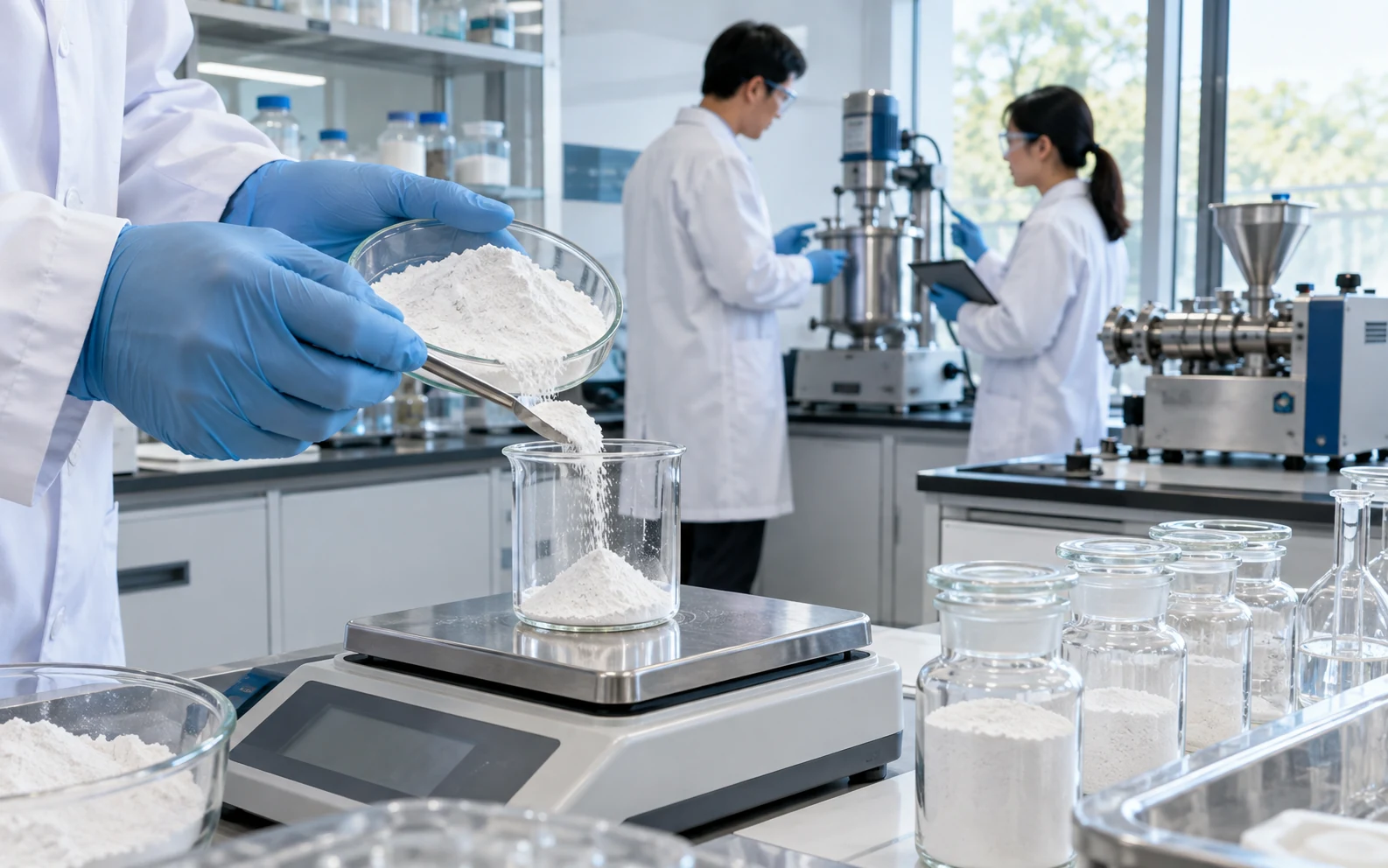
Through the joint-application work of the CAS collaboration laboratory, JINGYUAN helps turn initial trials into targeted, controlled and reviewable material validation. Define non-negotiable requirements first, then evaluate substitution, weight reduction or process improvement.
02Laboratory trial design
- Retain the current formulation as the baseline and use at least two dosage levels; add treatment or hybrid controls where needed.
- Control material batch, drying, mixing order, temperatures and specimen preparation; record actual processing conditions.
- Record gains and losses together; screen against essential requirements before comparing cost and processing stability.
- Repeat key measurements for selected formulations before assessing continuous production, batch variation and long-term use.
03Deliverables
Swipe to compare all columns ↔
| Stage | Deliverable | Decision supported |
|---|---|---|
| Plan agreement | Selection rationale, control formulations, tests, conditions and sample list. | Whether the trial is ready to start |
| Laboratory completion | Full property comparison, process records, cost basis and open questions. | Which formulations merit repetition or pilot testing |
| Pilot review | Process guidance, stability observations and quality checks on customer equipment. | Whether to proceed to scale-up and supply preparation |
04Include these in the cost assessment
Use the same performance requirements and production basis to account for material consumption and prices, part weight, cycle time, energy, scrap and rework. A single strength gain does not establish lower production cost; selected options must meet both quality and economic targets.
05Submit a project brief
Prepare the matrix and grade, end product, current filler, processing temperatures, targets and expected volume. Include an existing formulation or test sheet if available. If dosage is undecided, start with material selection and a sample plan.